Tree Removal in Severn, MD

Twenty years of removals, stump grinding and storm response across Anne Arundel County, quoted on site and written down before a crew is booked.

Severn Tree Removal has been taking trees down, cutting them back and hauling them off across Severn, MD and Anne Arundel County for more than 20 years. Tree removal is the core of the work, alongside stump grinding, tree trimming and pruning, land and lot clearing, emergency storm removal, crane-assisted takedowns, shrub and hedge removal, tree disease and plant health care, arborist risk assessment, and property-line jobs where a neighbor is part of the conversation.

Every job opens the same way: a free on-site estimate, with the scope written down before a crew is booked. That written scope names the inclusions people usually find out about the hard way — whether the brush is chipped and hauled, what happens to the trunk rounds, whether the stump is ground, and who is left with the pile of grindings. We would rather argue about the scope on the estimate visit than on the day the truck arrives.

We hold a 24-hour response for storm damage, fallen trees and trees resting on a structure, and we route a job’s permits before anything is scheduled, because five counties and four towns here answer the same question differently. Compact tracked equipment sized to pass a standard back-yard gate, crane support where there is no drop zone, and lawn and hardscape protection matting on every job are the rest of it. The crew that walks the property at the estimate is the crew that does the final rake-out.

Get Your Free Quote

Fast response • No obligation

So we can reach you about your request.

So we can send you a confirmation after you submit this inquiry form.

  • 20+ Years in Anne Arundel County
  • Free On-Site Estimates
  • 24-Hour Storm Response

What we do

Our Services

Tree removal and arborist care for Severn, Maryland

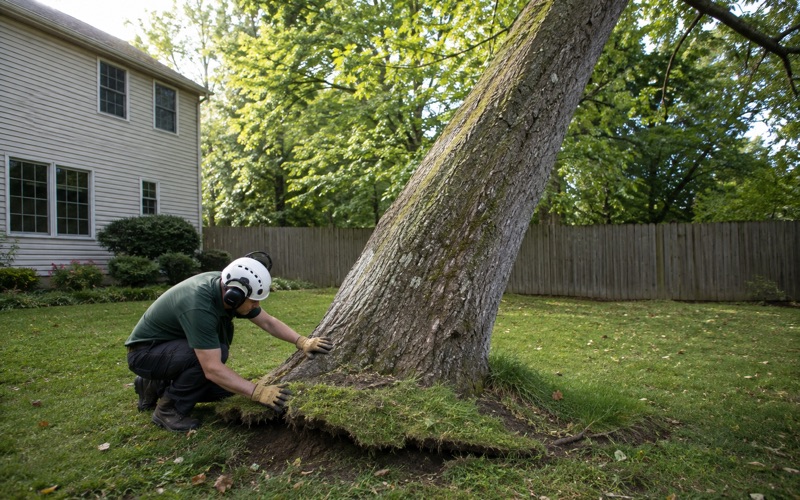
Worker crouched at the lifted root flare of a leaning tulip poplar in Severn, reading the fresh plate movement in the sandy soil after a summer squall.

Arborist

Written tree risk assessments in Severn, MD: defect, target and root-plate inspection, with an honest keep-or-remove finding you can act on.

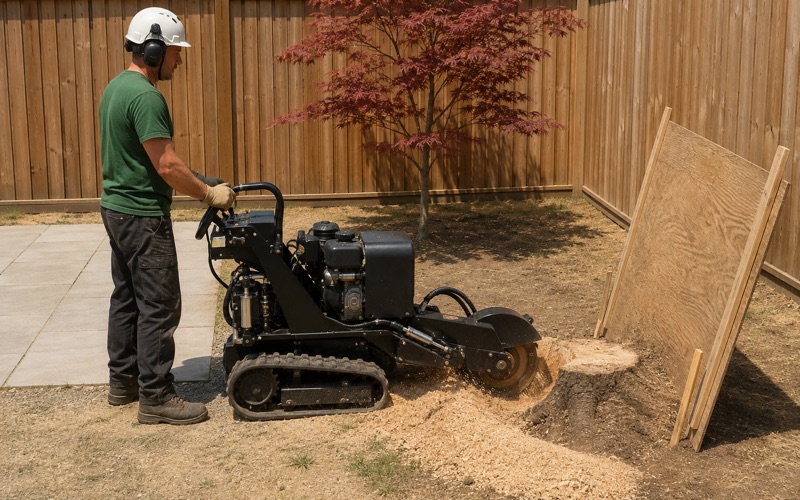
Worker sweeping a grinder wheel across a black cherry stump face in a Severn back yard, the free-draining sandy spoil piling light beside the cut.

Stump Grinding

Stump grinding in Severn, MD, ground below grade with the grindings, surface roots and lawn restoration all settled in writing before the crew arrives.

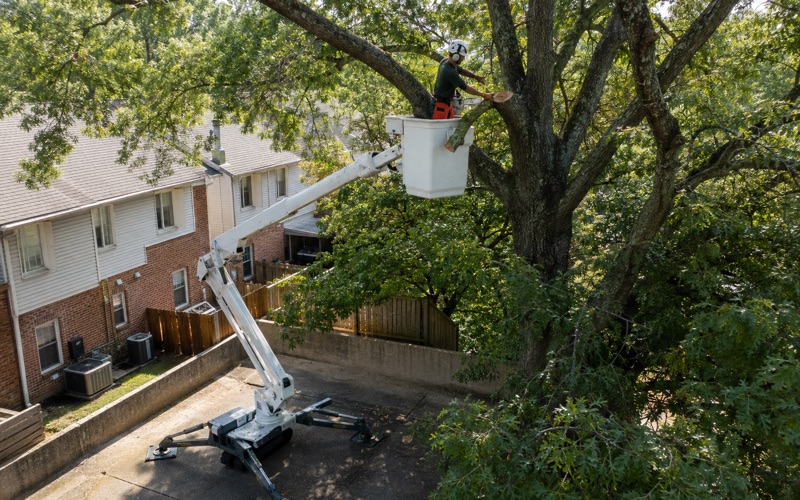
Worker in an aerial lift making a reduction cut at the branch collar of a willow oak over a Severn townhouse row.

Tree Trimming

Crown cleaning, thinning, raising and reduction in Severn, MD, specified to ANSI A300 so you can check the work against the estimate.

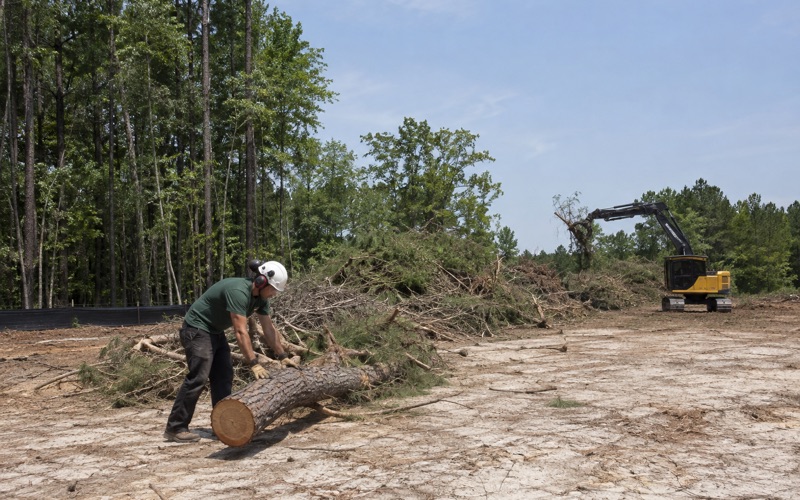
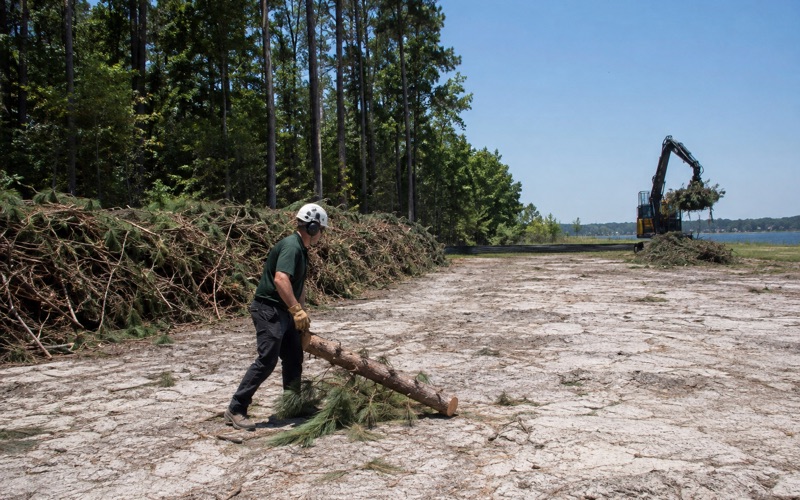
Worker rolling a Virginia pine cull log onto the windrow on a Severn clearing job, the tracked machine bunching brush behind him.

Land Clearing

Land and lot clearing in Severn, MD with stem count, stump disposition, debris route and finished ground condition all written into the estimate.

Worker at the stem of a sweetgum blown over whole in Severn, the root plate lifted clear of the sandy ground and the trunk caught on the back fence.

Emergency Tree Removal

24-hour emergency tree removal in Severn, MD for storm damage, fallen trees and trees resting on a structure, with make-safe and full cleanup priced apart.

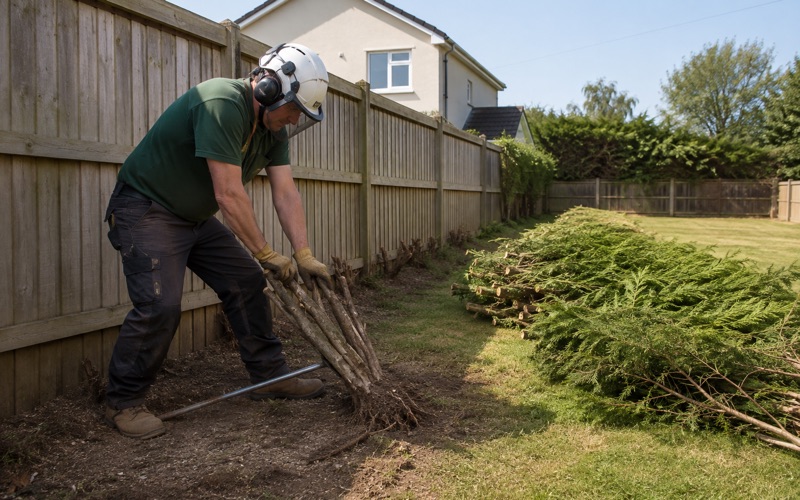
Worker pulling a leyland cypress stem cluster out of a Severn boundary hedge line after the tops have been taken off.

Shrub Removal

Shrub, hedge and brush removal in Severn, MD, with root-ball extraction, resprouting species and debris volume all settled at the estimate.

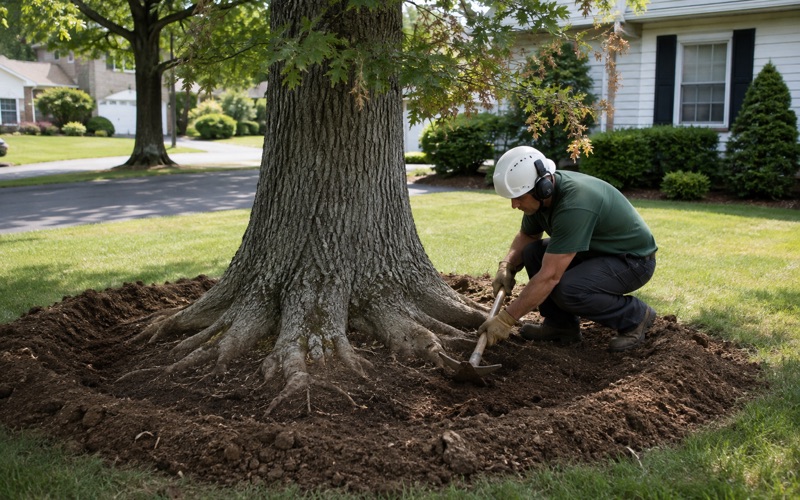
Worker breaking compacted soil at the root collar of a declining white oak in Severn, the flare exposed for inspection.

Tree Disease Treatment

Tree disease diagnosis and plant health care in Severn, MD: root collar excavation, soil decompaction and straight answers on ash borer and lanternfly.

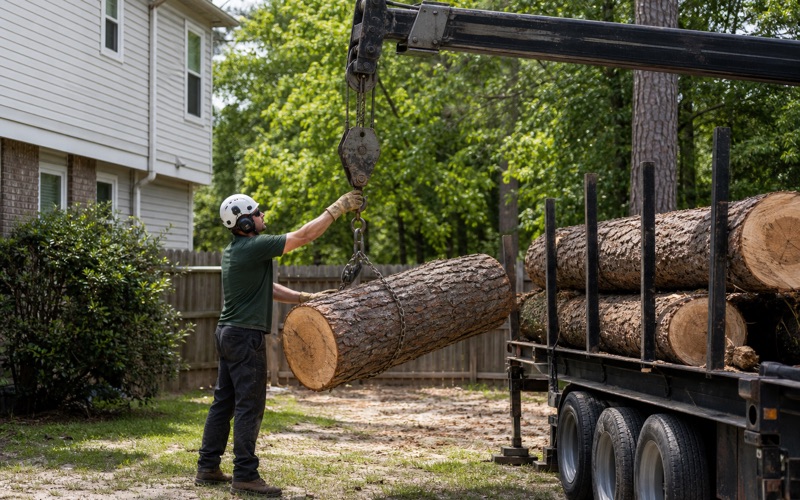
Worker setting a choker strap around a tulip poplar section in a Severn back yard with no drop zone, the crane hook block waiting above it.

Crane Tree Removal

Crane-assisted tree removal in Severn, MD for trees with no drop zone, lifting each section clear of the roof, pool and fence line.

Worker spreading protective tarp along the neighbor's side of a Severn boundary fence, the silver maple limbs cut back exactly to the line above.

Neighbor Tree Removal

Property-line and neighbor tree work in Severn, MD, with written hazard assessments and cutting scopes both households can read and check.

What Twenty Years of Anne Arundel Tree Work Buys

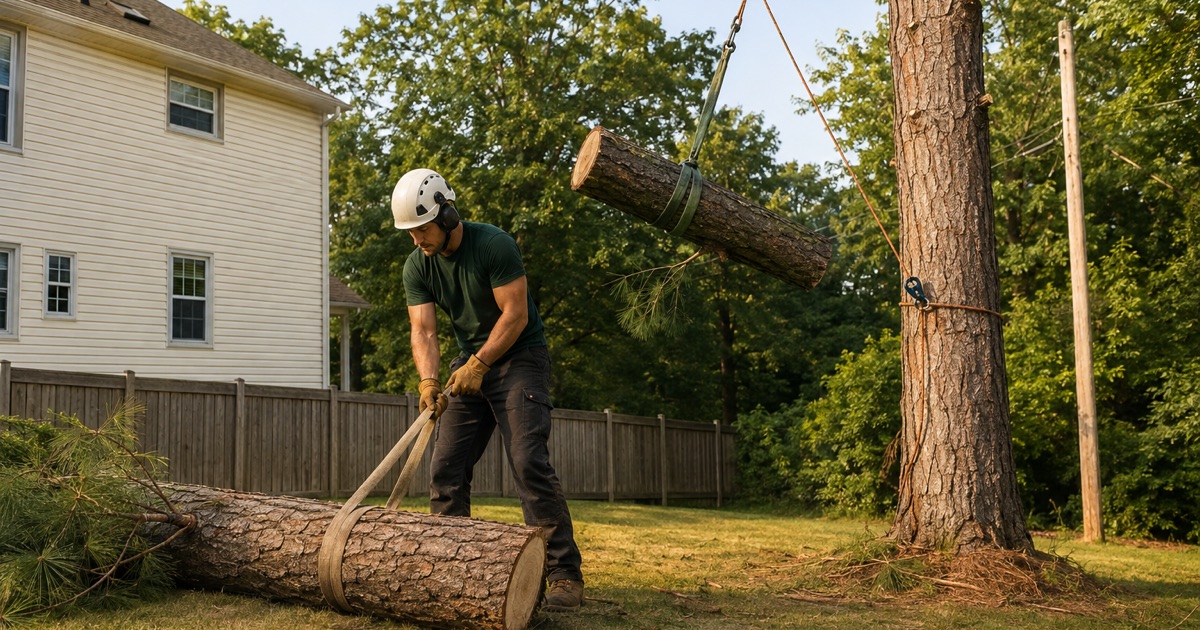
Worker at the base of a loblolly pine spar in a Severn back yard, one hand closed on the sling of a lowered section as the next one comes down on a summer evening.

Twenty Years on Local Trees

More than 20 years of removals, storm calls and pruning across Severn, Anne Arundel County and the Fort Meade corridor means the estimate is built from jobs already done on this ground rather than a national price sheet. We know how loblolly pine on deep Patapsco sand behaves in a summer squall, which back gates take a machine, and which of the nine local regulators answers before a saw starts.

Why Choose Severn Tree Removal

Written Removal Inclusions

Every removal quote names what leaves the property and what stays: brush chipped, rounds stacked or hauled, stump ground or left, grindings settled up front. County curbside takes limbs only under 4 feet by 4 inches in bundles under 40 pounds and will not take logs, so an unwritten inclusion becomes your problem rather than a priced line.

Permit Routing Before Scheduling

No crew is booked until the approvals are identified. Nine regulators cover this service area, and a roadside tree needs a DNR Roadside Tree Care Permit judged on where the trunk stands, so the address decides rather than the county name and the paperwork moves before the date does rather than after a stop-work conversation.

Machines Sized to the Gate

A standard stump grinder needs a gate roughly 35 inches wide to reach a rear yard, so machine width and not engine power decides most back-yard jobs here. We measure the access at the estimate and bring compact tracked equipment sized to pass it, rather than arriving with a machine that cannot clear the fence.

Crane Support Where There Is No Drop Zone

Never fell a tree into a space that will not hold it. Where a yard has no drop zone we bring crane-assisted removal and lift the sections clear of the roof or fence line, so the load leaves under control rather than being improvised over a house on a rigging plan nobody wrote down.

Storm Work That Stops on the Forecast

Maryland writes its own enforceable tree-care safety standard in COMAR 09.12.28, and it requires work to stop when the forecast calls for imminent hazardous weather. We follow it on storm calls, so a second front does not catch a climber in a damaged tree, rather than pushing a crew through a warning to clear a driveway.

Emergency and Storm Tree Work

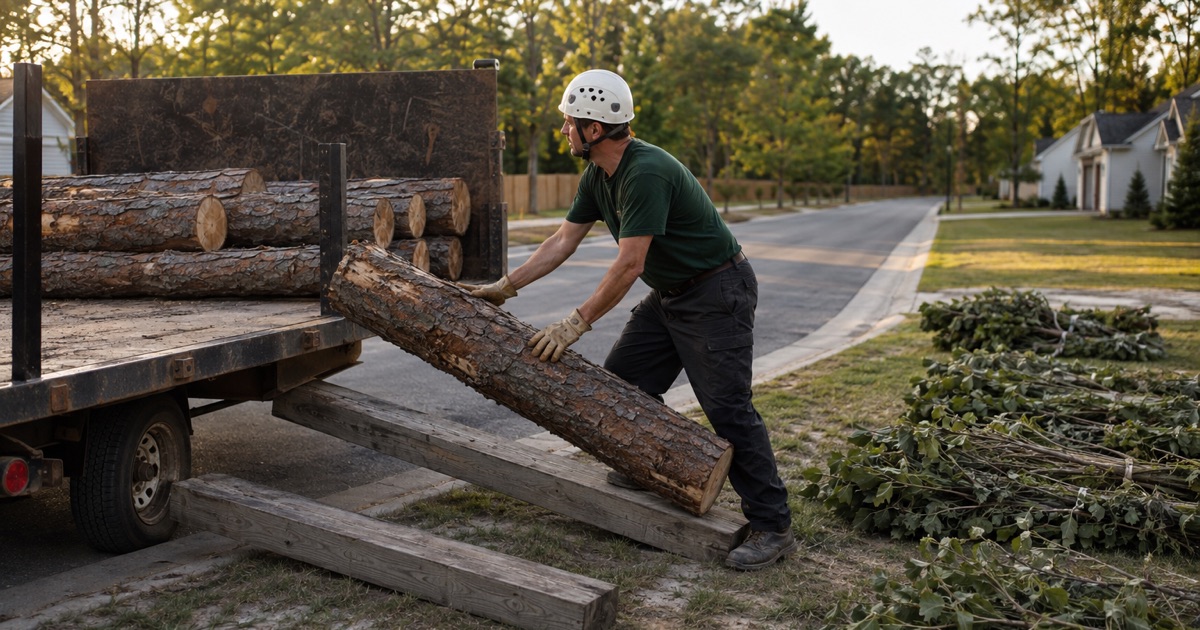
Worker rolling a short loblolly pine log up timber skids onto the crew trailer at a Severn curb, the county-size limb bundles stacked separately for collection.

First Moves When a Tree Comes Down on the House

Get everyone out of the rooms under the trunk, shut off gas and power to the damaged side if the panel is safe to reach, and photograph the tree where it landed. Then call us and your carrier in that order: stabilization stops the damage growing while the claim is still being opened.

Power Line Contact and the Order to Call

A tree or limb on an energized line is BGE’s call first and ours second, and nothing on our side starts until the line is de-energized or cleared. A limb blocking a road goes to the county or the state highway authority. Calling the tree company first on either one costs you the hours the utility needed anyway.

Storm Response After Convective Wind and Tornado Damage

The local storm record is led by summer convective severe-thunderstorm wind and tornadoes rather than hurricane remnants and nor’easters, and that changes what we find. Straight-line wind on deep sand uproots whole trees rather than snapping trunks, so our calls are more often a lifted root plate under an intact canopy.

Removing Trees Resting on a Structure

A tree leaning on a roof, a fence or a garage is holding load, and cutting it in the wrong order lets that load drop. We rig it, relieve the weight in stages and take the sections away from the structure rather than through it, which is why this is priced and planned differently from a standing removal in an open yard.

When Tree Work Stops: Maryland’s Hazardous-Weather Rule

COMAR 09.12.28 is Maryland’s own tree care and removal safety standard, enforceable where federal OSHA has no equivalent, and it requires all work to stop when the forecast calls for imminent hazardous weather. We tell customers that up front, because a storm crew that promises to work through the next cell is telling you something about how it runs every other job.

Standing Hazards a Storm Exposes

After a wind event we walk the whole property, not just the tree that failed. Split leaders, a new lean, co-dominant stems with included bark and a root plate lifted at the soil line are what comes down in the next storm, and they are cheapest to address while the crew and chipper are on site.

Crane-Assisted Removal Where There Is No Drop Zone

Some yards have nowhere to put a tree. Where the drop zone does not exist, a crane picks each section and swings it clear of the house, pool or neighbor’s fence, and nobody rigs a piece they cannot control. It costs more per hour and often less per job, measured in picks rather than days.

After-Hours Emergency Tree Removal Pricing

A scheduled removal is planned around crew availability, equipment and daylight. An after-hours storm call is none of those: it pulls a crew off rest, runs under lights and works around damage nobody has assessed. We price the two differently and say so before we roll, not on the invoice afterward.

Storm Debris the County Will Not Collect

Anne Arundel curbside collection takes limbs only under 4 feet by 4 inches, in bundles under 40 pounds, and will not collect logs. BGE does not remove wood debris after a line-clearance cut, and marked trees on its list run on its own schedule. A storm quote that ends at the curb leaves you with the half nobody hauls.

Documenting the Damage Before Cleanup Starts

Photograph the tree where it fell, the point of contact, and the interior damage before a saw touches anything, and keep the estimate that names the tree and the work. Carriers settle on what can be shown, and a cleaned-up yard is a harder claim than a documented one even when the loss is identical.

Tree Removal, Permits and Property Lines

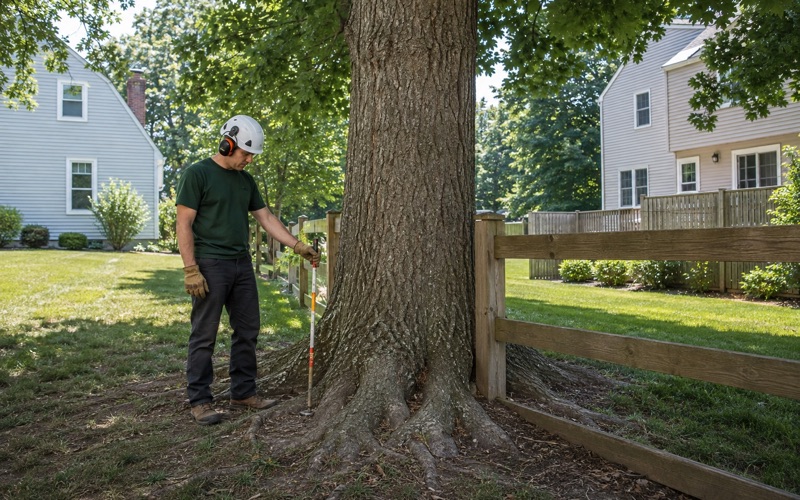
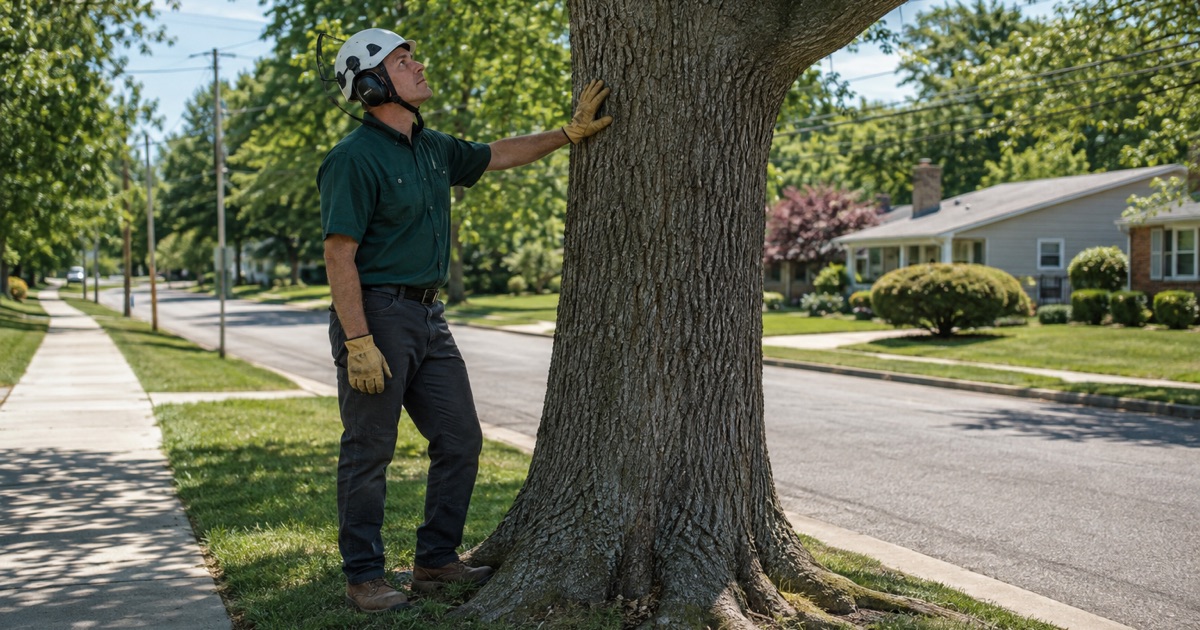
Worker at the bole of a large white oak standing in the Severn right-of-way between sidewalk and curb, the position of the trunk being what decides the permit.

Who Pays for Removal: You, a Carrier, the County or BGE

There is a ladder here and most people know one rung. Anne Arundel County does not entertain requests for trimming or removal of trees on private property, and BGE clears its lines but is not responsible for removing the wood debris. Your carrier pays under a sublimit, and the rest is the homeowner’s. We say which rung your tree is on before quoting it.

Maryland Licensed Tree Expert: The Requirement and the Check

Maryland requires a Licensed Tree Expert for tree work performed for hire, licensed through DNR under COMAR 08.07.07. That is a verifiable credential, not a logo, and the license number can be checked against the state list before anyone climbs. Ask for it from every company you get a quote from, ours included.

Roadside Tree Care Permits in the Right-of-Way

A tree standing in the public right-of-way needs a DNR Roadside Tree Care Permit before it is pruned or removed, and the test is where the trunk stands rather than who mows around it. Homeowners are regularly surprised that the tree between the sidewalk and the curb is not theirs to schedule. We check the trunk position at the estimate.

Nine Local Regimes Across One Service Area

This service area crosses five counties and four incorporated towns, and they give nine answers to the same job. Takoma Park writes the state Licensed Tree Expert requirement into city law and adds a site visit; Laurel runs its own forest conservation program; Prince George’s canopy ordinance exempts any permit pertaining to an existing single-family detached home.

A Neighbor’s Tree Over Your Line

Maryland follows the Melnick rule: you may cut back branches and roots that cross onto your property, at your own expense, up to the property line and no further, and you may not enter the neighbor’s land or destroy the tree doing it. Maryland also splits the duty to inspect between urban and rural land, and every city we serve is urban.

Arborist Reports Before Putting a Neighbor on Notice

If the tree is a genuine hazard rather than a nuisance, the conversation changes once there is a written arborist assessment naming the defect. It gives the neighbor something specific to act on, and it establishes what was known and when, which is the part that matters if the tree later fails onto your side.

What Homeowners Insurance Pays Toward Removal

The Maryland Insurance Administration puts the removal sublimit usually between $500 and $1,000, and says it is paid whether the tree damages an insured structure or just falls in your yard. That covers one medium removal in this market and rarely two, which is why we quote the whole job rather than assuming the policy absorbs it.

Per Event or Per Tree: The Question That Decides a Claim

Carriers do not agree on this and it is worth reading your own policy. The Maryland Insurance Administration states that the amount paid for tree removal is typically based on the event and not the number of trees that fall, while carrier materials sometimes describe a per-tree limit. On a storm that drops three trees the difference is the entire settlement.

Forest Conservation Thresholds and the Jobs They Never Reach

Forest conservation obligations attach at subdivision, grading or sediment control on sites at or above 40,000 square feet, along with a Declaration of Intent where one applies. An ordinary back-yard removal on a quarter-acre lot is nowhere near that line. We tell homeowners when a threshold is genuinely in play and, far more often, when it is not.

Overhanging Limbs, Roof Exclusions and Underwriting Notices

Carriers increasingly send inspection notices asking for limbs cleared off a roof, and some tie renewal to it. Clearing to a written crown raising or crown reduction spec under ANSI A300 satisfies the request without topping the tree, and the estimate names the work in the language the underwriter used so the photograph you send back closes the file.

Trimming, Pruning and Tree Health

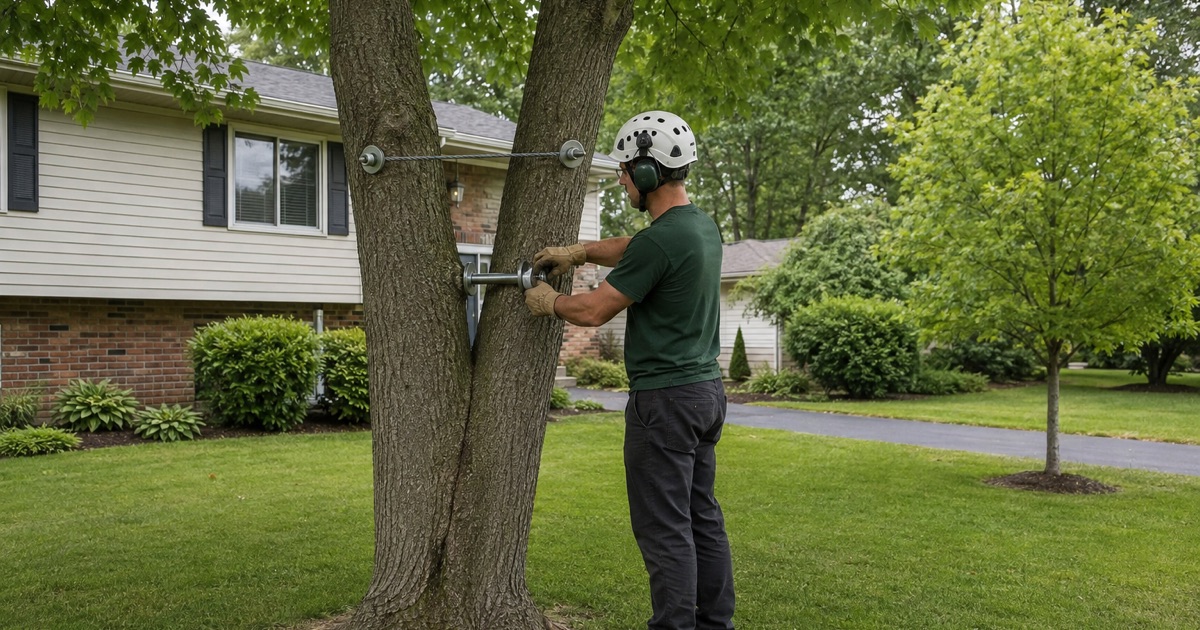
Worker fitting a brace rod through the union of a co-dominant red maple in a Severn front yard, the support system being the alternative to taking the tree out.

Removal or Retention: How the Call Gets Made

Most trees people ask us to take down do not have to come down. The assessment looks at the target underneath, the defect itself, and whether the defect can be mitigated by pruning, cabling or a soil fix. We say when a tree is keepable, because a company that never recommends retention is not assessing anything.

Published Thresholds for Lean, Hollow Trunk and Root Loss

A written assessment works against thresholds rather than opinions: how much of the cross-section is sound shell against a hollow, how much crown has been lost, how much of the critical root zone a trench or driveway severed, and whether a lean is old and corrected or new since the last storm.

Conks, Shedding Bark and What Each Symptom Means

Mushrooms at the root collar usually mean decay fungi are in the root plate, the part you cannot see or mitigate. Bark falling in sheets means the cambium under it is dead. Epicormic shoots mean the tree is answering stress. None is a verdict alone, and all three change the assessment.

Crown Reduction, Thinning, Raising and Cleaning

These are four different jobs and quotes often blur them. Crown cleaning takes out dead and broken wood, while crown thinning opens the canopy to reduce sail area. Crown raising lifts the lowest limbs off a roof or a driveway, and crown reduction shortens the whole crown to reduce end weight. The estimate names which one, in ANSI A300 terms.

Why Topping Is Not Pruning

Topping cuts limbs back to stubs with no lateral to take over, and the tree answers with weakly attached epicormic shoots on decaying stubs. Five years later the regrowth is taller, heavier and less securely attached than what was removed. It is the single most common thing we are asked to undo, and it is not a service we sell.

Cabling and Bracing Instead of Removal

Co-dominant stems with included bark are the classic split-in-a-storm failure, and they are often the only defect a large healthy tree has. A cable installed to specification shares the load between the stems and a brace rod resists the split directly, which frequently buys a specimen tree decades at a fraction of what removing and replacing it would cost.

Emerald Ash Borer and Brittle Dead Ash

Emerald ash borer has been established in Maryland since 2003, and dead ash goes brittle within about three years of mortality. That is the practical point for a homeowner: an ash that died two summers ago is no longer a normal climbing removal, and the window where it can be taken down cheaply and conventionally closes on its own.

Spotted Lanternfly and the Statewide Quarantine

Maryland’s spotted lanternfly quarantine went statewide effective 2026-03-06, so the whole of this service area is covered. It regulates moving logs, stumps, firewood and yard waste rather than requiring anything of a tree, and the Maryland Department of Agriculture is clear that the insect does not kill trees. For us it constrains disposal, not diagnosis.

Root Collar Excavation, Air Spade Work and Soil Decompaction

A tree buried too deep at planting, or one growing in soil compacted by construction traffic, declines slowly and for reasons nobody can see from the crown. An air spade excavates the root collar without cutting roots, exposes girdling roots and lets us decompact and amend the soil, which is the fix when the crown symptoms are only the report.

Prune Now or Remove Later: The Cost of Deferring

A deadwooding and crown reduction visit on a sound tree is a fraction of what an emergency removal costs, and a fraction again of what the removal plus roof repair costs. The cheapest version of almost every tree problem in this corridor is the one addressed while the tree is still standing on its own terms.

Stumps, Debris and Land Clearing

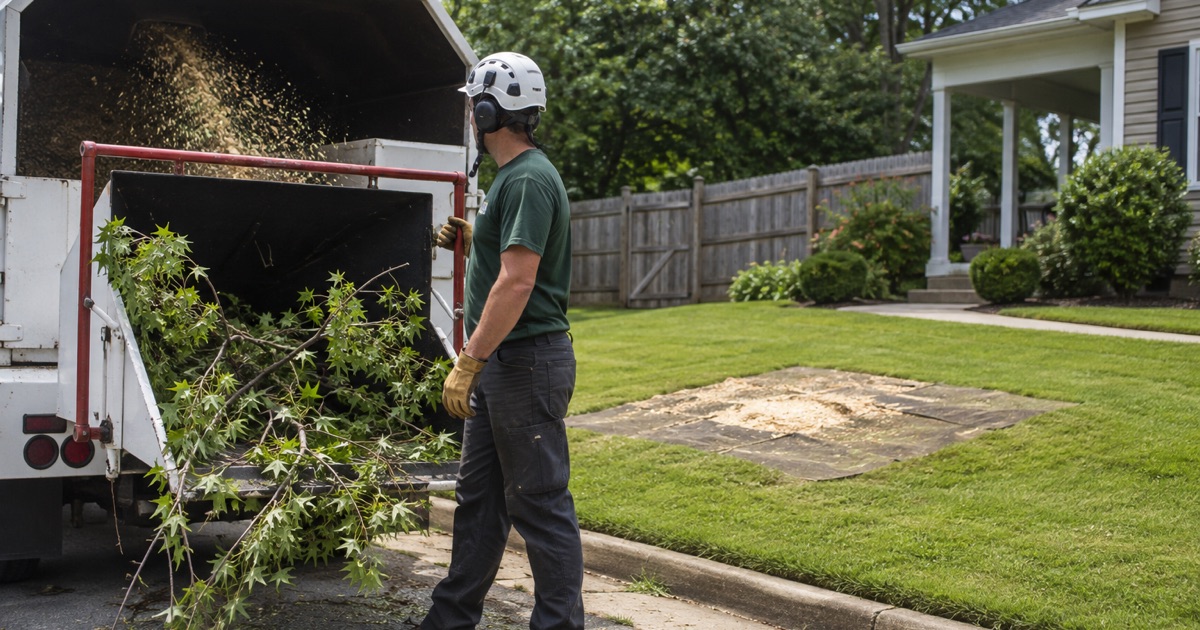
Worker loading brush into the chip box at the curb in Severn, the ground stump and its cone of fresh grindings on the lawn behind him.

Grinding a Stump Against Digging It Out

Grinding chews the stump and buttress roots below grade and leaves the surrounding soil intact. Excavating pulls the whole root plate and leaves a crater to backfill and settle. Grinding is faster, cheaper and far less disruptive on a finished lawn, which is why it is the default unless something is going in that spot.

What Stump Grinding Includes, and the Ground Afterward

The priced standard in this market is grinding 6 to 8 inches below grade, which clears turf, sod and most replanting. It is not a hole in the ground and it is not bare soil either: what is left is a shallow depression full of grindings, wood chips and soil mixed together, and that is the part worth agreeing in writing.

Topsoil, Seed and the Grindings Nobody Quotes

The single most common surprise on a stump job is the volume of grindings, because a ground stump occupies more space as chips than it did as wood. Hauling them off, backfilling with topsoil and seeding is a separate line and we price it as one, rather than leaving a mound on a lawn and calling the job complete.

Trunk Rounds, Brush and What Full Cleanup Covers

Full cleanup on our estimates means brush chipped and hauled, rounds removed, and the drop zone raked out. Local price lists routinely exclude permit fees, emergency calls, damaged or diseased trees, trees over 30 feet, stump grinding, trees near power lines and splitting firewood, so the exclusions are where two quotes that look alike stop being alike.

Drop and Leave: Paying Less by Keeping the Wood

If you burn wood or know someone who does, we can fell and buck the tree, leave the rounds stacked and skip the haul-off. It removes real cost from the job. Note that splitting firewood is named as a billable add-on in this market rather than a courtesy, so keeping the wood means keeping it as rounds.

Surface Roots Lifting a Driveway, Walkway or Patio

Cutting a lifting root is a trade, not a repair: every root severed inside the critical root zone reduces anchorage on a tree whose plate is already shallow in this sandy soil. We map what is structural before anything is cut, and where the tree is worth keeping the honest answer is often to change the hardscape rather than the roots.

Lot and Land Clearing Priced by the Acre

Clearing is quoted by the acre and the spread is enormous: ProMatcher put Anne Arundel area lot clearing at $1,000 to $10,000 per acre in Linthicum Heights in May 2023. Stem density, stump disposition, slope and haul distance move a quote inside that range, so a per-acre number means nothing unwalked.

Shrub, Hedge and Brush Removal

Overgrown foundation shrubs, an old privet hedge and a fence line gone to brush are their own job, with their own access problem and their own disposal volume. We take them out with the root balls where the bed is being replanted and grind them where it is not, and the debris goes out with the same chipper.

Where the Wood Goes: Chipping, Hauling and Disposal

Brush is chipped on site, rounds are loaded, and everything leaves under the quarantine rules that govern moving logs, stumps, firewood and yard waste in Maryland. County curbside is not a disposal route for any of it, so the estimate names the destination rather than assuming a truck will find one on the day.

Gate Width Decides Which Machine Shows Up

A standard stump grinder needs a gate roughly 35 inches wide to reach a rear yard, and in the townhouse and rowhouse blocks around this corridor many rear gates are narrower than that. We measure the access before quoting, and where the gate wins we bring a compact tracked machine, a walk-behind grinder or a crane pick instead of a rescheduling call.
Areas We Serve

Severn Tree Removal provides tree removal throughout the greater Severn area, with the same crews and the same standards on every job.

Good to know

Frequently Asked Questions

How much does tree removal cost in Severn?

It depends on height, lean, what sits underneath the tree and how a machine reaches it, which is why we quote on site. As a benchmark, the ProMatcher Research Team put a standing removal under 30 feet in this area at $453.72 to $561.18 as a fixed fee in May 2021, with stump work priced separately by diameter.

Is the estimate really free, and what does it include?

Yes, and there is no charge for a second look at a tree you are unsure about. The visit covers the access, the gate width, the species and defect, and whether the trunk sits in a right-of-way, and it leaves you a written scope naming the inclusions rather than a number on a card.

Does Maryland require a license to remove a tree?

Maryland requires a Licensed Tree Expert for tree work performed for hire, administered by the Department of Natural Resources under COMAR 08.07.07. Ask any company for its license number and check it against the state list before work starts. A quote that cannot produce one comes from someone the state has not licensed to give it.

How quickly can you respond to a storm emergency?

We hold a 24-hour response for storm damage, fallen trees and trees resting on a structure. What we will not do is work a tree while the forecast calls for imminent hazardous weather: Maryland's own safety standard requires work to stop, and the second cell of a storm is when climbers get hurt.

How long does a typical removal take?

Most single-tree removals run a day from setup to final rake-out, including chipping the brush and loading the rounds. Crane picks are often shorter, since the tree leaves in a handful of lifts. Stump grinding is frequently a separate visit, because the machine that fits the gate is not always on the removal truck.

Can your equipment reach a fenced back yard?

Usually, and it is a measurement rather than a hope. A standard stump grinder needs a gate around 35 inches wide, so we measure the access on the estimate and match the machine to it: compact tracked equipment for a standard gate, a walk-behind grinder for the tight ones, or a crane pick over the fence.

Do I need a permit before a tree comes down?

Sometimes, and the address decides it rather than the county. A tree in the public right-of-way needs a DNR Roadside Tree Care Permit, some towns add their own requirement, and forest conservation attaches at development thresholds an ordinary back-yard job never reaches. We identify what applies and route it before scheduling.

What happens to the wood, brush and grindings?

Brush is chipped and hauled, rounds are removed or left stacked if you want the firewood, and grindings are hauled off or raked back in, whichever the written scope says. County curbside will not take logs and takes limbs only under 4 feet by 4 inches in bundles under 40 pounds.

Is there a better time of year for tree removal?

Dormant-season work is easier to schedule and easier on the tree for pruning, and a bare canopy shows defects that leaves hide. Removals run year-round. The timing rule that actually costs money is a dead ash: it goes brittle within about three years, and waiting turns a routine climb into a specialized job.

Will my homeowners insurance pay for it?

For a tree that has already fallen, often partly. The Maryland Insurance Administration puts the removal sublimit usually between $500 and $1,000, payable whether the tree hit an insured structure or just landed in the yard, and says the amount is typically based on the event rather than the number of trees. Removing a standing tree is maintenance.

Ready to Get Started?

Request a free quote today and we'll get back to you fast.