Severn Tree Removal has put an arborist in front of homeowners’ trees across Severn, MD for more than 20 years, serving surrounding cities including Fort Meade, Jessup, Elkridge, Odenton and Glen Burnie. An arborist assessment is the visit that answers the question underneath almost every call we get: does this tree have to come down, or can it be kept, and what does the evidence actually say?
It is a different service from a removal quote, and it is worth being clear about why. A removal quote prices a decision you have already made. An assessment tests the decision itself — the defect, the target underneath it, the likelihood of failure and the consequences if it happens — and it writes the finding down in language a neighbor, an insurance adjuster or a county reviewer can read.
Anne Arundel County does not entertain requests for trimming or removal of trees on private property, so on a residential lot the assessment is yours to commission and yours to act on. We give you the finding in writing, whether or not it results in work for us. A company that only ever recommends removal is not assessing anything; it is selling.
What a Tree Risk Assessment Covers
Target, Defect and Likelihood
A risk assessment is not a verdict on the tree in isolation. It looks at what is underneath and around it — a house, a driveway where cars park, a play set, a road — because the same defect on the same species carries a different risk over a shed than over a bedroom. We record the target, the defect and the likelihood of failure separately, so you can see which of the three is actually driving the recommendation and what would change it.
Measuring the Tree: DBH, Crown and Root Zone
The measurements a report rests on are diameter at breast height, crown spread and condition, and the extent of the critical root zone and how much of it has been disturbed. Those numbers are what make a report checkable a year later rather than a memory of a conversation. They also decide which local rules apply, since several ordinances in this service area are written in terms of DBH.
What Gets Written Down and What It Is For
The written assessment names the species, the measured defect, the recommendation and the alternatives that were considered and rejected. That matters most where somebody else has to act on it: a neighbor being put on notice about a tree over the line, an HOA board approving work, an adjuster deciding what a claim covers, or a buyer’s agent reading a tree preservation notice attached to a contract of sale.
Species Identification and Site History
Loblolly pine is native and common here and the coniferous share of the local woodland is real, while northern red oak is documented as rare on the coastal plain and an identification of one should be confirmed rather than assumed. Getting the species right is not pedantry — it sets the expected failure mode, the decay organisms worth looking for, and how fast a dead stem becomes unsafe to climb. Because 41.9 percent of Severn’s housing was built in 2000 or later, many lots carry planted landscape trees under 25 years old alongside retained construction-era specimens, and those two groups fail for completely different reasons.
Reading the Defects on Coastal Plain Soil
Root Plates, Windthrow and Deep Sand
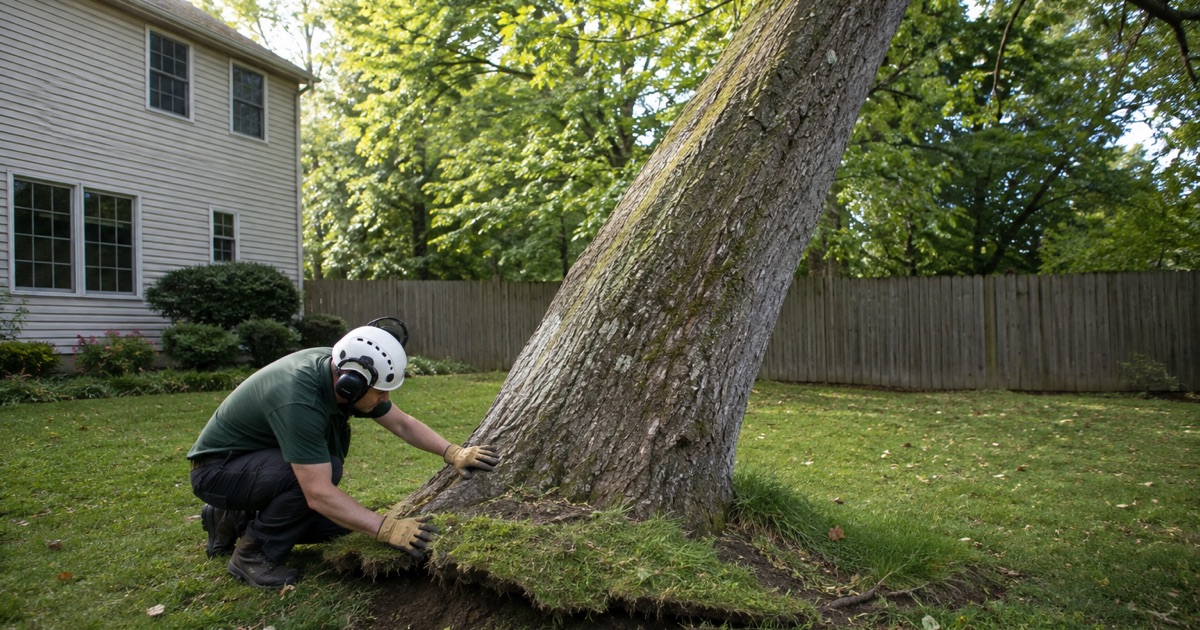
Severn sits on Patapsco-family sands: deep, loose and fast-draining. Large trees rooted in that develop broad, shallow root plates rather than deep anchorage, which is the classic setup for whole-tree windthrow in a summer squall rather than a trunk snap. Our assessments here weight the root plate and the soil at the collar heavily, because the failure mode we actually see in this corridor starts below grade.
Co-Dominant Stems and Included Bark
Two stems of similar size competing for the same union, with bark folded into the join instead of wood, is the most common structural defect on an otherwise healthy shade tree. It is also one of the few that is genuinely fixable. Where the union is sound enough, cabling and bracing shares the load and keeps a specimen tree standing; where it is not, the assessment says so before a storm does.
Decay, Epicormic Shoots and Crown Symptoms
Mushrooms at the root collar, bark coming off in sheets, deadwood high in the crown and epicormic shoots along the scaffolds are each evidence of something different, and none is a verdict on its own. We read them together and against the tree’s history — a trench cut for a utility line three years ago explains a decline that the crown alone does not.
Pests That Matter and Pests That Do Not
Emerald ash borer has been established in Maryland since 2003 and is a genuine structural issue, because dead ash turns brittle within about three years and stops being a conventional climbing removal. Spotted lanternfly is the opposite case: Maryland’s quarantine went statewide effective 2026-03-06, and the Maryland Department of Agriculture is clear that the insect does not kill trees. It constrains how logs, stumps, firewood and yard waste are moved rather than what happens to the tree, and an assessment that treats it as a mortality risk is telling you something inaccurate.
Assessments That Have to Satisfy Someone Else
Reports for a Neighbor or a Boundary Dispute
Maryland lets you cut back branches and roots that cross your property line at your own expense, and no further. Where the tree is a genuine hazard rather than a nuisance, a written arborist report changes the conversation: it names the defect, establishes what was known and when, and gives the neighbor something specific to act on instead of an opinion traded over a fence.
Insurance, Underwriting Notices and Claims
Carriers send inspection notices asking for limbs cleared off a roof, and they tie renewals to them. An assessment written in ANSI A300 terms — crown raising to a stated clearance, crown reduction to a stated spec — answers the notice without topping the tree, and the same document supports a claim later by dating the condition of the tree before the loss.
Permits, Specimen Trees and Development Thresholds
Several jurisdictions here define a specimen tree by measurement — in Prince George’s County, 30 inches DBH or more, or 75 percent of the DBH of the current state champion of that species. Forest conservation obligations attach at subdivision, grading or sediment control on sites of 40,000 square feet or more. An assessment identifies which line your tree is near before anyone files anything.
HOA Boards, Property Managers and Multifamily Grounds
Common-area trees are decided by a board or a manager who was not standing under the tree, and often on a meeting schedule rather than a storm schedule. A dated written assessment with measurements and photographs is what travels into that room, and we schedule the site work around board meetings and grounds access rather than expecting a community to work around us. Where several trees are involved we prioritize them by target and likelihood, so a limited budget goes to the stems actually over the parking court.
Our Step-by-Step Tree Risk Assessment Process
Step 1: The Site Walk
We walk the whole property rather than the one tree you called about, because the tree that fails is often not the tree that worried you. Access, gate widths, overhead lines and drop zones are recorded on the same visit, so any recommendation that follows is one we already know can be executed on your lot.
Step 2: Inspection From the Ground and Above
Ground-level inspection covers the root collar, the buttress roots, the trunk and the visible unions. Where the crown cannot be read from below, an aerial lift or a climbing inspection under ANSI Z133 gets an arborist to the defect rather than guessing at it through binoculars.
Step 3: The Written Finding
You get the species, the measurements, the defect, the target, the recommendation and the alternatives, in writing and dated. Where retention is viable we say what retention requires — a cable, a crown reduction, a soil fix — and what it does not solve.
Step 4: Scope, Permits and Scheduling
If work follows, the assessment becomes the scope: a written estimate naming the inclusions, the permit route identified before a crew is booked, and the same crew from that visit through the final rake-out. If no work follows, the report is still yours and still dated.
- 20+ Years in Anne Arundel County
- Free On-Site Estimates
- 24-Hour Storm Response