Severn Tree Removal handles neighbor tree removal and property-line tree work throughout Severn, MD, and after more than 20 years of it we have learned that the hard part is almost never the cutting. It is establishing what you are allowed to do, what you are responsible for, and what a written record needs to say before anyone starts.
Maryland’s rule is narrower than most people expect. You may cut back the branches and roots that cross onto your property, at your own expense, up to the property line and no further. You may not enter your neighbor’s land to do it, and you may not do it in a way that destroys the tree. That is the self-help right, and it is the whole of it.
What changes the picture is a hazard. A tree with a documented defect, on a lot in an area treated as urban, sits under a duty to inspect that a wooded rural parcel does not carry. Every city in this service area is urban for that purpose, which is why a written arborist assessment is worth so much more than an argument over a fence.
What You May and May Not Do
Trimming to the Line at Your Own Cost
Overhanging branches and encroaching roots on your side are yours to cut, and the bill is yours as well. The limit is the property line: cutting past it, or entering the neighbor’s yard to get a better angle, is not covered by the right. We write scopes for this work that state exactly where the cuts land, so both households can see the boundary being respected.
Not Destroying the Tree in the Process
Cutting everything on your side of a tree whose trunk sits on the other side can kill it, and doing so exposes you rather than the owner. Where trimming to the line would take too much of the crown or too much of the critical root zone, the honest answer is that the work needs the owner’s agreement, and we will say that instead of taking the job.
Trees Straddling the Line
A tree whose trunk sits on the boundary itself is a different matter from one that merely overhangs, and it is generally treated as belonging to both owners. Decisions about removing it are joint decisions. The practical route is a written scope both parties sign, which is more common than people expect and considerably cheaper than the alternative.
Fences, Roots and Hardscape Damage
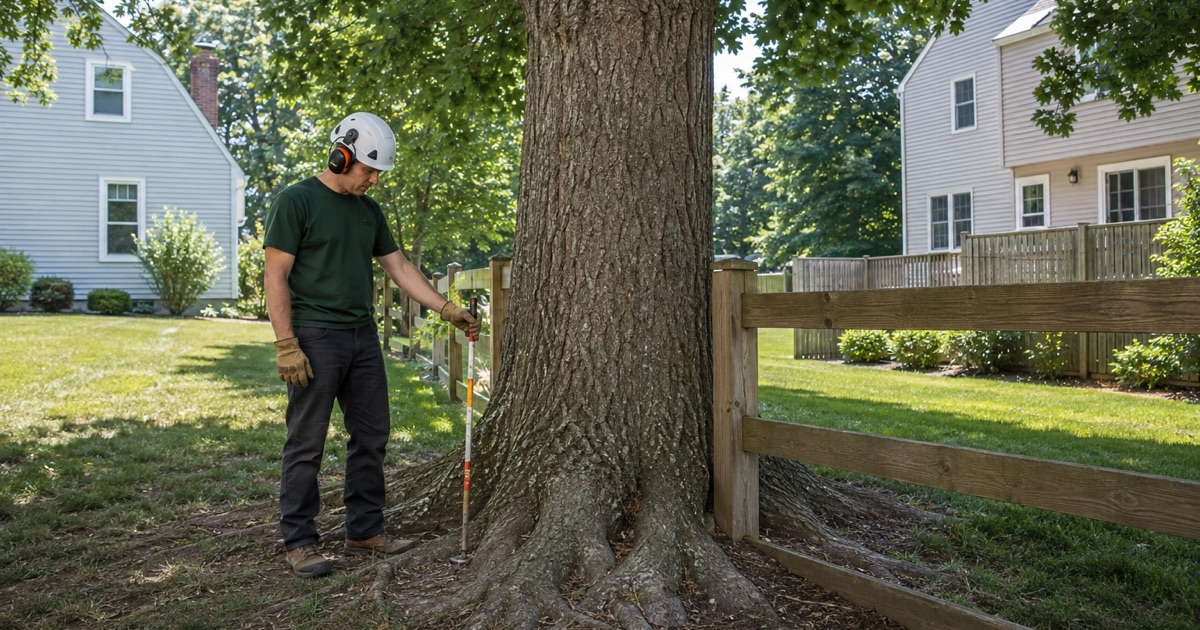
Roots lifting a driveway, a walkway or a fence line are among the most frequent property-line calls we get. Cutting a structural root is a trade rather than a repair, since every root severed inside the critical root zone reduces anchorage on a tree whose root plate is already shallow in this sandy soil. We map what is structural before anything is cut.
When the Tree Is a Hazard
The Duty to Inspect, and Where It Applies
Maryland distinguishes between urban and rural land in what an owner is expected to know about their own trees, and every city in this service area is urban for that purpose. That means a hazardous tree on a developed lot is not simply an act of nature waiting to happen; it is something the owner can be expected to have inspected.
Getting an Assessment Before You Give Notice
A written arborist assessment naming the species, the defect, the measurements and the target is what turns a complaint into a matter of record. It gives your neighbor something specific to act on, and it establishes what was known and when — which is the part that matters if the tree later fails onto your side.
Putting a Neighbor on Notice
Notice works best in writing, attached to the assessment, and stated as information rather than a threat. Most of these situations resolve at that point, because a documented defect changes what the owner’s own insurer and their own contractor will tell them. We provide the document; how it is delivered is your call.
After a Tree Has Already Fallen
Once a neighbor’s tree is down in your yard, it is generally your property and your claim, which surprises almost everyone. The exception is a tree that was a documented hazard the owner had been notified about. That is the whole reason to get the assessment done while the tree is still standing rather than afterward.
Getting the Work Done Cleanly
Scopes Both Households Can Read
We write property-line scopes in plain measurements: which limbs, cut back to which laterals, to what clearance, on whose side of the line. A scope written that way can be shown to a neighbor before work starts and checked by anyone afterward, which removes most of the heat from the conversation.
Access by Agreement
Doing the work from the other side is usually easier, safer and better for the tree, and it needs the owner’s permission. Where that permission is given we work to a single written scope for both properties. Where it is not, the job is planned around working entirely from your side, and we say what that costs in tree health.
Local Rules That Still Apply
Property-line agreement does not replace a permit. A tree in the public right-of-way still needs a DNR Roadside Tree Care Permit judged on where the trunk stands, and jurisdictions here define protected and specimen trees by measurement — Prince George’s County uses 30 inches at breast height, or 75 percent of the state champion of that species. The address decides which rules attach.
HOA and Managed Property Boundaries
In townhouse and condominium communities the boundary is frequently between an owner and the association rather than between two households, and the decision sits with a board or a manager. A dated written assessment is what travels into that meeting, and we schedule the work around board approvals and grounds access rather than expecting a community to move for us.
- 20+ Years in Anne Arundel County
- Free On-Site Estimates
- 24-Hour Storm Response