
Severn Tree Removal takes on land clearing across Severn, MD and the surrounding cities including Fort Meade, Jessup, Elkridge, Odenton and Glen Burnie, with more than 20 years of work on this ground behind the estimate. Clearing ranges from opening a half-acre back lot for a shop building to taking a wooded parcel down to grade for a builder, and the two jobs share a machine list and almost nothing else.
The number that surprises people is the spread. Quoted by the acre, clearing in this area runs across an order of magnitude: the ProMatcher Research Team put Anne Arundel area lot clearing at $1,000 to $10,000 per acre in Linthicum Heights in May 2023, and its statewide Maryland figure averaged $2,330.98 per acre with a range of $1,532.70 to $3,129.26. Nothing inside that range means anything until someone has walked the parcel.
The other thing that decides a clearing job here is not the trees. It is which approvals attach to the work, and that answer changes by address across five counties and four towns. We identify the route before a machine is scheduled, because the expensive version of this job is the one that starts and then stops.
What Sets a Clearing Price
Stem Density and Size Distribution
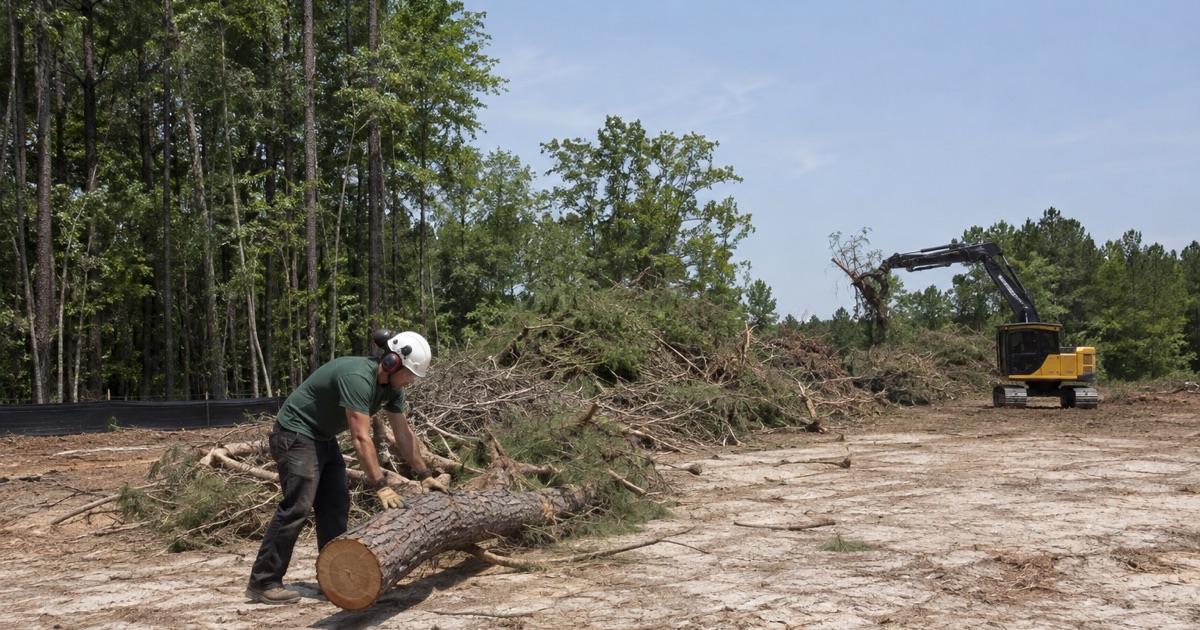
An acre of pole-sized pine and an acre carrying mature hardwood over 24 inches at breast height are the same area and completely different jobs. Density decides machine hours; the largest stems decide which machines can be used at all and whether anything has to be climbed or craned rather than pushed. We count and measure rather than eyeballing an acreage figure from a map.
Stump Disposition
Whether stumps are ground, excavated or left in place is often the single largest line in a clearing quote, and it is set by what the ground is for afterward. A pasture, a paddock or a yard tolerates ground stumps; a building pad, a driveway or anything with a footing does not. Deciding this at the estimate rather than mid-job is what keeps the number from moving.
Haul Distance and Disposal Route
Chipping on site is cheap; hauling stems and grindings is not, and the cost scales with distance and with how many loads the material makes. Maryland’s spotted lanternfly quarantine regulates moving logs, stumps, firewood and yard waste statewide, so the disposal route is a planned part of the job rather than something a driver improvises.
Access, Slope and Working Room
A parcel a machine can drive onto is a different price from one reached through a neighbor’s easement or a 12-foot gap between houses. Slopes here are usually gentle — much of this area sits on ground rated at only a few percent grade — so working room and access width, rather than grade, are normally what limit the equipment we can bring.
Approvals, Thresholds and What They Reach
Forest Conservation and the 40,000 Square Foot Line
Forest conservation obligations attach when an application is made for subdivision, a grading permit or a sediment control permit on a site of 40,000 square feet or more. That is a development trigger rather than a tree trigger: it is the permit that pulls the requirement in, not the act of cutting. Plenty of clearing on smaller parcels never touches it, and we say so plainly when it does not.
Declaration of Intent
Where the work qualifies, a Declaration of Intent is the mechanism that records a limited, stated purpose for clearing instead of triggering the full plan process. It is a filing with conditions attached, not a loophole, and the conditions bind the property afterward. We identify when the route is available and what it commits you to before anything is signed.
Chesapeake Bay Critical Area
The Critical Area does not reach Severn itself — a spatial query of the county’s Critical Areas layer against the CDP boundary returns nothing at all — but it does reach several communities we serve closer to tidal water. Where it applies, buffer obligations, a Vegetation Management Plan and clearing caps come with it, and clearing without checking is an expensive way to find out.
Roadside Trees and Jurisdiction You Do Not Own
Trees in the public right-of-way need a DNR Roadside Tree Care Permit judged on where the trunk stands, and some land adjoining state holdings is outside both county jurisdiction and a private owner’s control — the Severn Run corridor is a Maryland DNR Natural Environment Area, for instance. The boundary of what you may clear is not always the boundary of your deed.
What Clearing Looks Like on the Ground
Selective Clearing and Tree Retention
Most residential clearing is better done selectively than wholesale. Keeping a handful of sound specimen trees changes what a finished lot looks like and what it is worth, and it costs less than removing them. The trees worth keeping are chosen on structure and root condition rather than on size, since a large tree with a compromised root plate on loose sand is a liability on an open lot.
Brush, Undergrowth and Invasive Stems
A great deal of what makes a parcel impassable is not trees. Tree of heaven, brambles, honeysuckle and volunteer scrub take the same time to clear and produce more volume per acre than the timber does. Tree of heaven in particular resprouts aggressively from cut stumps and roots, which is worth planning for rather than discovering the following spring.
Grading, Debris and What Is Left Behind
Clearing leaves ruts, root holes and a soil surface that has been driven over repeatedly. We say in the estimate what condition the ground is handed back in — rough-cleared, raked, or graded — because those are three different prices and the gap between what a client pictured and what was quoted usually lives right here.
Working Around What Stays
Fences, septic fields, wells, driveways and any tree being retained all constrain machine paths, and the constraint has to be planned rather than avoided by luck. Lawn and hardscape protection matting goes down where finished surfaces are crossed, and retained trees get their critical root zones kept clear of traffic, since compaction is what kills a kept tree two years after the job.
Our Step-by-Step Land Clearing Process
Step 1: Walk the Parcel
We walk the whole area with you, mark what stays, note access and boundaries, and record the stems that will drive the price. This is also where the approval question gets asked, since the answer depends on the parcel size, the address and what you intend to build.
Step 2: Identify the Approval Route
Before a date is offered, we establish which of the local regimes applies, whether a development threshold is in play, and whether any tree sits in a right-of-way or an area with its own requirements. Permit routing happens ahead of scheduling rather than alongside it.
Step 3: Written Scope and Fixed Inclusions
The estimate names the area, the stems, the stump disposition, the debris destination and the finished ground condition. Everything that would otherwise be assumed is a line on the page, so a change in scope is a conversation rather than an invoice surprise.
Step 4: Clear, Process and Hand Back
The crew fells and processes on site, chips what chips and loads what does not, grinds or removes stumps as scoped, and leaves the parcel in the agreed condition. The same crew that walked it with you at the estimate is the one that finishes it.
- 20+ Years in Anne Arundel County
- Free On-Site Estimates
- 24-Hour Storm Response