Severn Tree Removal handles shrub removal across Severn, MD and the wider Anne Arundel County service area, and after more than 20 years here we treat it as its own job rather than something tacked onto the end of a tree quote. Foundation plantings, an old privet hedge, a fence line gone to brush and a bed of overgrown yews each behave differently once you start pulling them out.
The thing that makes shrub work awkward is not the plants. It is that shrubs live in the places machines cannot go — against a foundation, inside a fenced side yard, on top of an irrigation line, under a window well — so a job that looks like an afternoon can turn into hand work if nobody looked first.
Everything is quoted on site and written down before a crew is booked, including what happens to the root balls and where the debris goes. The debris volume is the part people underestimate: an overgrown hedge produces more material by volume than the tree next to it.
What Comes Out, and How
Root Ball Extraction Against Cutting to Grade
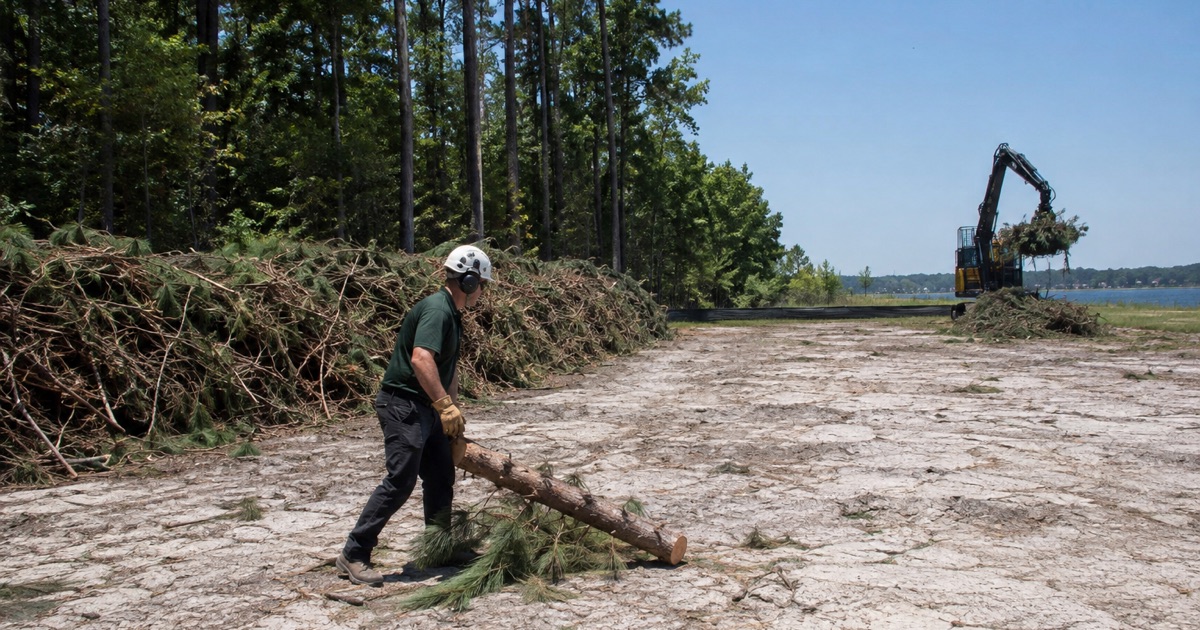
There are two honest answers to removing a shrub and they cost differently. Pulling the root ball leaves a clean bed ready for replanting and a hole to backfill. Cutting to grade and grinding the crown is faster and cheaper, and it is fine where sod or mulch is going over the top. The estimate says which one you are buying rather than leaving the finish to chance.
Species That Resprout and Species That Do Not
Yews, boxwood and most conifers do not come back from a cut stump. Privet, forsythia, honeysuckle, bamboo and tree of heaven very much do, and any of them cut to grade will be back within a season. Where a resprouting species is involved, extraction rather than cutting is usually the only removal that stays removed.
Hedges, Screens and Partial Removal
Taking out half a hedge is harder than taking out all of it, because the remaining plants have grown into their neighbors and lose their form when the support goes. We say when a partial removal is going to look bad and offer the alternatives — a hard renovation prune, a staged replacement, or taking the whole run and starting again.
Working Against Foundations and Hardscape
Shrubs planted tight to a wall put roots under footings, walkways and porch slabs, and the roots are frequently what is holding a settled paver in place. We hand-dig against structures rather than pulling with a machine, because the cheap version of this job is the one that cracks a foundation parge coat or lifts a step.
Brush, Fence Lines and Overgrown Areas
Fence Lines Gone to Brush
A fence line left alone for a few years grows a dense strip of volunteer stems, vines and brambles that is genuinely difficult to work and takes a fence apart from underneath. Clearing it means working from one side, cutting to the line and dealing with what is rooted on the neighbor’s side by agreement rather than by reaching over.
Invasive Stems Worth Naming
Tree of heaven is the one to identify before anyone cuts. It resprouts aggressively from cut stumps and from roots several feet away, so cutting a stand of it without a plan multiplies it. English ivy, porcelain berry and multiflora rose are the other regular offenders in this area, and each has its own reason for coming back.
Bed Renovation and Starting Over
Where a foundation bed has become a thicket, clearing it back to bare soil is usually cheaper than trying to save individual plants, and it gives whoever replants a surface they can actually work. We take the root balls out on a renovation rather than grinding, since a new planting into old root mass and chips rarely establishes well.
Access, Matting and the Finished Surface
Most shrub work happens on lawn a machine has to cross to reach. Lawn and hardscape protection matting goes down on every job, and where a side yard is too narrow for a machine at all the work is done by hand and priced accordingly. That constraint is identified at the estimate, not on the morning.
Debris, Disposal and What It Costs
Why Volume, Not Weight, Drives the Price
A hedge run produces an enormous volume of light, springy material that fills a chipper truck long before it approaches a weight limit. Loads, not pounds, are what shrub disposal costs, which is why an overgrown bed can price higher than the small tree standing beside it. Nobody likes hearing that, so we would rather show the arithmetic at the estimate.
What County Curbside Will Not Take
County curbside collection takes limbs only under 4 feet by 4 inches, in bundles under 40 pounds, and will not take logs or root balls. A shrub job that ends with material stacked at the curb is a job that has been handed back to you. Ours ends with the material gone, and the estimate names where it goes.
Quarantine Rules on Moving Yard Waste
Maryland’s spotted lanternfly quarantine is statewide and regulates the movement of logs, stumps, firewood and yard waste. It does not mean your shrubs are infested; it means disposal follows rules, and a crew hauling material across county lines is doing so under them rather than around them.
Combining Shrub Work With Other Jobs
Mobilization is a real share of the cost on any small job, so shrub removal booked alongside a tree removal, a stump grind or a hedge trim is materially cheaper than the same work on its own visit. If you have been putting several small things off, it is worth listing them all at the estimate.
- 20+ Years in Anne Arundel County
- Free On-Site Estimates
- 24-Hour Storm Response