Severn Tree Removal has handled tree trimming in Severn, MD for more than 20 years, serving surrounding cities including Fort Meade, Jessup, Elkridge, Odenton and Glen Burnie. Trimming is the work that decides whether a tree stays an asset or turns into a removal quote in five years, and unlike a removal it is almost entirely reversible in the wrong direction: cuts made badly cannot be taken back.
Everything we cut is specified in the vocabulary of ANSI A300, the industry pruning standard that Maryland incorporates by reference under COMAR 08.07.07. That matters because it makes an estimate checkable. “Trim the oak” is not a scope. “Crown raise the oak to 14 feet over the driveway and reduce the two limbs overhanging the roof by 6 feet to lateral” is a scope, and you can stand in the yard afterward and see whether it was done.
Climbing and aerial lift work runs under ANSI Z133, the safety standard for arboricultural operations, and on storm-adjacent work Maryland’s own COMAR 09.12.28 requires work to stop when the forecast calls for imminent hazardous weather. Those are not sales points; they are the reason a crew declines a day you might want them to work.
The Four Pruning Types, and Which One You Need
Crown Cleaning
Crown cleaning removes dead, dying, diseased and broken wood from the canopy and nothing else. It is the lowest-risk pruning there is, it is what most mature trees near a house actually need, and it is the work that removes the pieces most likely to come out of a tree in the next storm. Deadwooding a large oak over a driveway is usually the highest-value hour anyone spends on that tree.
Crown Thinning
Thinning selectively removes live branches to reduce density through the canopy, which cuts sail area and lets wind pass through instead of pushing on a solid crown. It is easy to overdo: stripping the interior and leaving foliage only at the ends produces lion-tailing, which moves weight outward and makes limb failure more likely rather than less. Thinning is specified as a percentage, and a modest one.
Crown Raising
Raising removes the lowest limbs to give clearance over a driveway, a walkway, a roof or a sight line. It is the cut most often requested by an insurance inspection notice, and it is specified as a clearance height rather than a number of limbs. Raising too far in one visit shifts the tree’s center of mass upward and leaves a stem with no low taper, so it is done in stages on a young tree.
Crown Reduction
Reduction shortens the whole crown or a section of it by cutting back to a lateral large enough to take over as the new leader. It is how you deal with a tree that has outgrown its space or with end-weighted limbs over a structure, and it is skilled work: each cut has to land on a viable lateral rather than a stub. Done properly the tree keeps its shape at a smaller size.
Why Topping Is Not On the Menu
What Topping Actually Does
Topping cuts limbs back to arbitrary stubs with no lateral to assume the terminal role. The tree responds with a flush of epicormic shoots attached only to the outer wood of a stub that is already decaying, and within a handful of years the regrowth is taller and heavier than what was cut, attached far less securely. It is the single most common thing we are asked to undo.
The Storm Argument Turned Around
People top trees hoping to make them safer in wind. The result is the opposite: a topped tree carries dense weakly attached regrowth on decaying stubs, which is a better description of storm debris than of a storm-hardened tree. Proper reduction and thinning achieve the actual goal, which is less end weight and less sail area on sound attachments.
Repairing a Previously Topped Tree
A tree that was topped some years ago can often be brought back partway. The work is restoration pruning: selecting one or two of the strongest shoots on each stub to become new leaders, removing the rest, and repeating over several visits as the selected stems take over. It is slower and cheaper than removal, and it is a legitimate answer for a tree that still has good roots.
What We Will Say No To
We will not top a healthy tree, and we will not cut a specimen tree back to a size the client picked out of the air, because we would be selling the removal that follows it. Where the request is really about light, a view or a roof, there is normally a specified reduction, raise or thin that gets most of the way there without ruining the tree.
Timing, Species and Tree Health
Dormant-Season Work and Why It Is Easier
Pruning in the dormant season is easier on most trees and easier to do well, because a bare canopy shows structure, defects and dead wood that leaves hide. Scheduling is also more available. There are exceptions worth knowing: some species bleed heavily from late-winter cuts, and some disease pressures make certain months a bad idea for particular trees.
Pruning Young Trees While It Is Cheap
Because 41.9 percent of Severn’s housing was built in 2000 or later, a large share of local lots carry planted landscape trees under 25 years old. Structural pruning on a tree of that age costs very little and decides what the tree will be at forty: one leader instead of two, no included bark at the main union, and clearance established gradually rather than cut in all at once later.
Storm-Season Priorities on Shallow Root Plates
The local storm record is led by summer convective wind and tornadoes rather than hurricane remnants, and on deep sandy soil the failure that follows is usually a whole tree going over rather than a trunk snapping. Reducing end weight and sail area on the crown is worth doing, and so is being honest that no amount of pruning saves a tree whose root plate has already lifted.
Pruning as an Alternative to Removal
A great many removal calls end with a reduction, a cable and a deadwooding instead. Co-dominant stems with included bark, a heavy limb over a bedroom, a tree that has simply grown into the house — each has a pruning answer that costs a fraction of removal and replacement. We say when it exists, and we say plainly when it does not.
Access, Permits and Getting the Work Done
Aerial Lift, Climbing and Rigging
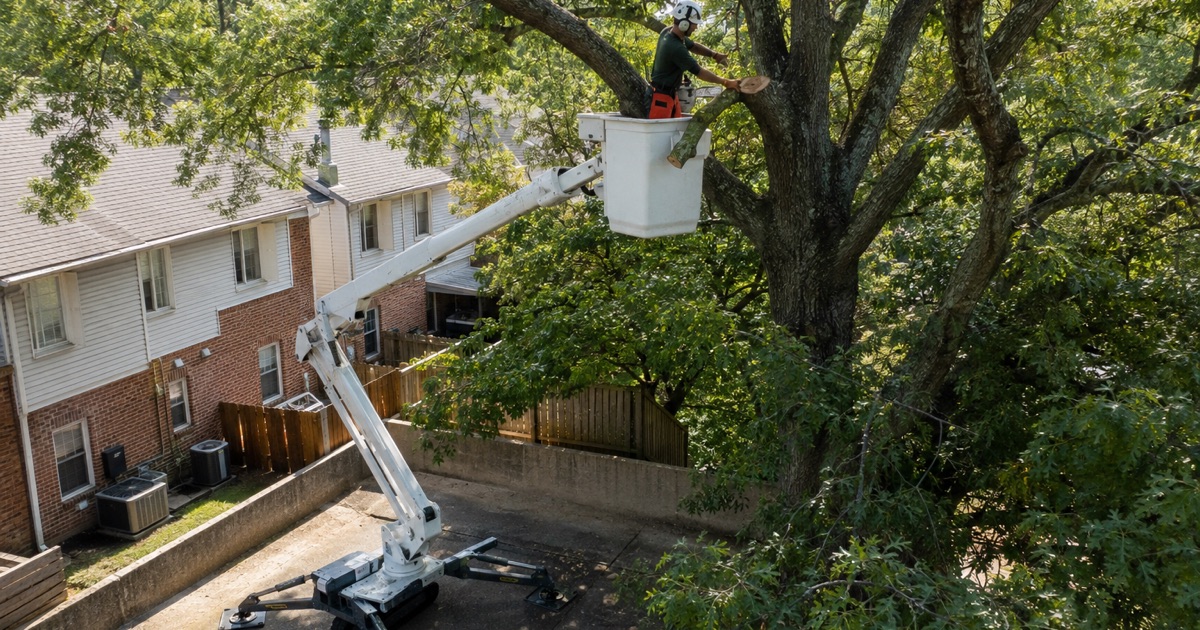
Which method we use is decided by the tree and the ground under it. A lift is quick and safe where there is stable footing and clearance; a climber reaches what a lift cannot; and where limbs are over a roof, a fence or a pool, each piece is rigged and lowered rather than dropped. All of it runs under ANSI Z133, including the parts that slow a job down.
Trees in the Right-of-Way
A tree standing in the public right-of-way needs a DNR Roadside Tree Care Permit before it is pruned, and the test is where the trunk stands rather than who mows the strip. The tree between the sidewalk and the curb is frequently not yours to schedule. We check the trunk position on the estimate visit so the permit route is identified before a date is offered.
Limbs Near Utility Lines
Anything within reach of an energized conductor is the utility’s work, not ours, and BGE handles its own line clearance on its own schedule. We prune the rest of the tree and coordinate rather than working adjacent to a live line. Where BGE has already cut for clearance, note that it is not responsible for removing the wood debris it leaves behind.
HOA Common Areas and Managed Properties
Common-area trimming is decided by a board or a property manager and scheduled around residents, parking and access rather than around us. We write scopes in specification language a board can approve without being in the yard, and schedule around meetings, grounds crews and multifamily access so a community is not asked to work around a tree crew.
- 20+ Years in Anne Arundel County
- Free On-Site Estimates
- 24-Hour Storm Response